
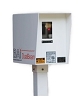
How do I determine whether I need a complete BA-440 reader, a rebuilt decoder, or an internal electronics assembly?
Choose a complete BA-440 when the enclosure, optical window, internal electronics, wiring, or overall condition is damaged or uncertain. Choose a replacement internal electronics and laser assembly when the enclosure and site hardware are reusable but the decoder or optics have failed. Consider a manufacturer-rebuilt decoder only after confirming its contents, warranty, firmware, configuration, and exchange requirements.
Separate the BA-440 Into Serviceable Sections
The BA-440 system should not be treated as one indivisible part. The reader installation includes the weather enclosure and optical window, the internal decoder and laser-optics assembly, the output board, a 24VDC power source, mounting hardware, and field communication wiring. A failure in one section does not automatically justify replacing the complete reader.
Start by recording the complete model and serial number, then inspect the reader before disconnecting anything. Note whether it powers up, produces the normal laser pattern, recognizes a known valid decal, sounds its buzzer or relay, sends credential data to the access panel, and remains stable under load. These observations identify how far the replacement needs to go.
When to Choose a Complete BA-440 Reader
A complete BA-440-B or BA-440-C reader is the safer choice when the existing unit has broad physical or electrical damage, when several assemblies have failed, or when the reader’s history cannot be verified. Typical examples include a broken or badly scratched optical window, bent or leaking enclosure, heavy internal corrosion, fire damage, flooding, vehicle impact, missing harnesses, damaged optics, or repeated failures after lightning exposure.
A complete reader also makes sense for a new lane or when an older unit has been modified with unidentified parts. Current manufacturer listings identify BA-440-C with two-year warranty coverage and BA-440-B with five-year coverage. The performance platform is the same; the warranty term is the main published difference.
Do not assume a complete reader includes the post, external supply, or high-endurance output board. Those components are separately listed in the BA-440 combo packages. Confirm the exact package contents before deciding that no additional support hardware is required.
When to Choose a New Internal Electronics Assembly
Select a BA-440 replacement decoder or internal electronics assembly when the NEMA enclosure, optical window, mounting, 24VDC supply, output board, and field wiring are all serviceable, but the internal decoder or laser-optics section has failed. Current manufacturer pricing lists BA-440-DEC-2 as the replacement decoder with two-year warranty coverage and BA-440-DEC as the replacement decoder with five-year coverage.
Distributor descriptions may identify these assemblies as fully assembled internal electronics and laser optics. Verify exactly what is included with the current part before replacement, including the decoder, laser components, internal harnesses, mounting hardware, and any site-programming service. Do not assume the enclosure, output board, or external power supply is included.
This replacement level is appropriate when the reader receives correct 24VDC but does not create the proper laser pattern, cannot decode known-good decals, will not communicate through its service interface, or has a confirmed internal electronics fault. The enclosure must remain dry, mechanically straight, and optically clear enough to protect the new assembly.
When a Manufacturer-Rebuilt Decoder May Be Appropriate
A manufacturer-rebuilt BA-440 decoder can be a practical service option when the existing reader shell and support hardware remain usable and the project can accept rebuilt internal electronics. The BA-440-DEC-NWS is commonly described in distributor data as a manufacturer-rebuilt BA-440 decoder, but its current warranty, included components, availability, and return or core conditions should be confirmed before selection.
Use the same diagnostic standard applied to a new decoder assembly. A rebuilt decoder will not correct a cracked window, leaking cabinet, weak 24VDC supply, failed output board, damaged Wiegand cable, or access-panel programming error. Installing rebuilt electronics into a wet or surge-damaged enclosure can create another failure.
Also confirm that the rebuilt assembly is configured for the property’s barcode formats, facility codes, Wiegand bit format, and credential ranges. Current manufacturer guidance states that new BA-440 readers and replacement decoders include the newer multi-format firmware, and units returned for repair receive the firmware update. Site-specific settings still need to be preserved.
Do Not Replace the Decoder for an Output-Side Failure
If the BA-440 scans the decal, beeps, and shows the correct credential through RS232 or USB diagnostics but the access panel receives nothing, the internal decoder may be working. Check the BA-440 high-endurance output board, Data 0, Data 1, communication common, relay contacts, grounding, surge damage, and access-panel input before replacing the reader or decoder.
Likewise, if the reader resets, loses its laser, or behaves inconsistently across every decal, measure the 24VDC input at the reader under load. A weak supply, long undersized cable, corroded splice, or loose terminal can imitate an internal electronics failure.
Technician’s Corner
Use a Known-Good Decal and Read the Event Log
Test a credential that is known to work at another entrance. A reader beep without a panel event points toward the output path. A panel event with the wrong number points toward Wiegand format or configuration. No optical response points back toward the decal path, laser, decoder, or power.
Inspect the Enclosure Before Installing New Electronics
Look for water tracks, condensation, corrosion around connectors, a cloudy or damaged window, failed gaskets, insects, and loose internal mounts. South Florida humidity, salt air, irrigation, and wind-driven rain can damage the cabinet slowly without an obvious external crack.
Lightning Damage Can Cross Several Assemblies
A surge can damage the decoder, output board, power supply, communication common, and panel input at the same time. Replacing only the most visibly damaged board may leave a second fault in the circuit. Test power and data paths independently before commissioning the replacement.
Preserve Site Configuration Before Removal
Record the reader serial number, active decal formats, facility codes, Wiegand bit length, serial settings, and accepted credential ranges. A mechanically correct replacement can still deny every resident or employee when it is not configured for the existing site.
Before You Choose the Replacement Level
- Verify the complete BA-440 model, serial number, and warranty configuration.
- Check the enclosure, optical window, seals, harnesses, and internal corrosion.
- Measure regulated 24VDC at the reader while energized.
- Test a known-good decal and note whether the reader beeps or clicks.
- Review RS232, USB, or access-panel event data when available.
- Test the output board, Wiegand wiring, relay, and panel input separately.
- Confirm DDF firmware, barcode formats, facility codes, and Wiegand bit format.
- Verify the exact contents, warranty, and return terms of rebuilt or new decoder assemblies.
Related Technical Categories
- BA-440 Complete Readers
- BA-440 Replacement Decoders
- BA-440 Internal Electronics and Laser Assemblies
- BA-440 High-Endurance Output Boards
- BA-440 Enclosures and Optical Windows
- BA-440 Power Supplies and Communication Cables
Before selecting replacement hardware, verify the reader model, serial number, enclosure condition, decoder part number, firmware, barcode formats, facility codes, Wiegand output, connector and harness arrangement, 24VDC supply, output-board revision, warranty, and package contents. Two BA-440 service parts can appear to solve the same symptom while replacing very different portions of the reader.
