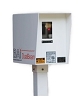
How high and how far from the vehicle lane should a BA-440 reader be mounted?
Using Barcode Automation’s standard mounting geometry, install the BA-440 with the bottom of the reader approximately 44 inches above the pavement and position it about 24 inches from the nearest side of the passing vehicle. Place it roughly 25 feet before the gate or barrier, facing the decal side of traffic and perpendicular to the vehicle path.
Use the Standard 44-Inch Reader Height
The current BA-440 position diagram shows the bottom of the reader 44 inches above the roadway surface. This standard height places the DualBeam laser pattern where it can cover common passenger cars, SUVs, pickups, and other vehicles when the reader is also positioned at the recommended lateral distance.
Measure the 44-inch dimension from the pavement at the reader location to the bottom of the BA-440 enclosure. Do not measure from the top of a six-inch curb, landscape island, or elevated concrete pad unless the reader’s final elevation has been recalculated against the vehicle pavement. Raising the post on a curb without compensating for curb height moves the entire laser field upward.
The mounting post should be plumb and rigid. A post that leans toward or away from the lane changes both the effective reader height and the location where the laser pattern crosses the vehicle window. A loose base plate can also allow the reader to drift after vehicles, landscaping equipment, or storm conditions disturb the island.
Position the Reader About Two Feet From the Vehicle Path
Barcode Automation recommends placing the BA-440 approximately 2 feet back from the nearest side of passing vehicles. The manufacturer’s side-view diagram represents this as a 24-inch spacing between the reader and the expected vehicle-side path. Measure to where the credentialed side of the vehicle will actually pass, not simply to a painted lane stripe or curb face.
At approximately 2 feet from the reader, the standard DualBeam pattern covers decals about 35 to 65 inches above the pavement. That range is intended to catch decals mounted at different window heights while the vehicle moves through the read zone. At the published maximum standard-decal range of 6 feet, the vertical read area expands from about 6 to 95 inches above the ground.
A wider offset may be workable within the published read range, but it also allows more lane-position variation and changes the vertical beam spread. Do not intentionally push the reader to the maximum distance when a stable two-foot vehicle path can be created with curbing, lane markings, or an island.
Place the Reader Before the Gate, Not at the Stop Line
The BA-440 should normally be installed approximately 25 feet, or about one and one-half car lengths, before the gate or barrier arm. This gives the reader time to identify the decal and allows the vehicle to pass the reader before it must stop for a slower swing gate, slide gate, overhead door, or roll-up barrier.
If the reader is installed too close to the gate, a vehicle may stop beside the reader instead of moving through the complete scan area. That can create inconsistent identification when the decal is already past the laser, outside the intended window, or blocked by the driver’s stopping position. Barrier-arm lanes may allow a smoother approach, but the read location should still be established before the controlled opening.
Choose Driver-Side or Passenger-Side Placement
The BA-440 may be installed on either side of the lane, but the decals must be mounted on the same side of the vehicles as the reader. Before setting the post, confirm that the selected side will work at every entrance where the same vehicles are expected to enter.
A property with one driver-side reader and another passenger-side reader may force residents or employees to carry decals on both sides or create inconsistent read performance. A written site plan should identify reader side, decal side, traffic direction, lane centerline, curb location, and gate position for every entrance.
Keep the Reader Perpendicular to Traffic
The BA-440 should face the side of the approaching vehicle and be positioned perpendicular to the roadway. Rotating the enclosure toward the gate, toward approaching headlights, or along the direction of travel can shift the scan field and reduce the time the decal remains inside the usable read area.
Verify the final aim with actual vehicles rather than relying only on the post dimensions. Test a low passenger car, a typical SUV or pickup, and any commercial vehicle type that regularly uses the entrance. Confirm that the decal path passes through the laser field without requiring the driver to hug the curb or make an unnatural steering correction.
Technician’s Corner
Ramp Slope Changes the Effective Height
Parking-garage ramps require extra attention because the vehicle rises or falls relative to the post as it approaches. Measure from the pavement at the exact scan location and evaluate the decal path through the beam. A reader mounted to the standard dimension on a sloped island may still scan too high or too low if the vehicle pitch is not considered.
Curbs Are Not the Vehicle Reference Point
The manufacturer’s example diagram shows a six-inch curb and approximately seven inches from the post centerline to the curb. Those dimensions illustrate one mounting arrangement, but the critical operating dimension is the reader-to-vehicle spacing. Wide gutters, bollards, landscaping setbacks, or drivers traveling away from the curb can move the decal beyond the expected two-foot path.
Solid Gates Can Change Where Vehicles Stop
A slow swing or slide gate may cause drivers to stop farther back than expected, especially when the leaf moves toward the approach lane or wind slows the operator. Establish the reader position around the real stopping behavior, not only the gate’s closed position. The vehicle should pass the BA-440 completely before waiting.
South Florida Sites Need Rigid, Corrosion-Resistant Mounting
Wind, salt air, irrigation, standing water, and corrosion at the post base can gradually change alignment. Inspect anchors, the base plate, conduit entry, drainage, and enclosure fasteners. Small movement at the post can produce a much larger shift in the read area several feet away.
Before You Set the BA-440 Post
- Measure 44 inches from vehicle pavement to the bottom of the reader.
- Maintain approximately 24 inches from the reader to the nearest vehicle side.
- Place the reader about 25 feet before the gate or barrier.
- Choose one consistent driver-side or passenger-side decal strategy.
- Keep the reader plumb and perpendicular to the vehicle path.
- Account for curbs, islands, gutters, ramp slope, and lane wander.
- Test low cars, SUVs, pickups, and regularly used commercial vehicles.
- Confirm the vehicle passes the reader before stopping.
Related Technical Categories
- Barcode Automation BA-440 Readers
- BA-440 Mounting Posts and Combo Packages
- Barcode Automation Vehicle Decals
- Barrier Gate Operators
- Vehicle Detection and Loop Detectors
- Access-Control Wiring and Power Supplies
Before finalizing the installation, verify the BA-440 model, mounting-post dimensions, pavement elevation, reader height, lateral vehicle path, decal side, expected vehicle types, gate setback, ramp slope, lane geometry, power and communication routes, and operator generation. Similar-looking site layouts can require different post positions when vehicles approach, turn, stop, or travel at different heights.
Tagged Products