
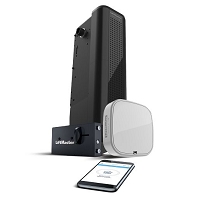
Can I install two wallmount openers between three garage doors with limited center clearance?
Maybe, but only if each wallmount opener has its own required clearance, shaft extension, mounting surface, power access, lock location, and safety-device layout. The center space between three garage doors often becomes too tight when two operators, two couplers, wiring, locks, lights, and service access are all considered together.
The Center Post Counts as an Obstruction
With three garage doors, the space between doors is usually a center pier, center wall, masonry column, framed divider, or structural post. That center area may look usable until you measure from each torsion shaft end to the nearest obstruction. For wallmount garage openers, the nearest obstruction may be the center post, the adjacent opener body, the next torsion shaft, a drum, a flag bracket, conduit, shelving, or finished trim.
A wallmount, jackshaft, or side-mount opener drives the torsion shaft directly. That means each opener must sit square to its own shaft with enough room for the motor body, coupler, mounting bracket, set-screw access, wiring, emergency release, and future service. If two units are squeezed between two doors, the center space has to satisfy both opener layouts at the same time.
Two Openers Need Two Complete Clearance Zones
Do not measure the center bay once and assume both openers will fit. Each door has its own torsion shaft, end bearing plate, cable drum, cable path, and opener-side clearance requirement. If one opener mounts on the right side of the left door and another mounts on the left side of the center door, those two operators may compete for the same center-post space.
The fitment check should include side clearance from each obstruction to each torsion bar end, shaft extension past each bearing plate, wall-to-shaft spacing, ceiling-to-shaft spacing, and usable wall surface behind each mounting bracket. If the operators overlap, touch, block each other’s covers, or prevent coupler access, the layout should not be forced.
Shaft Extension Can Stop the Layout
The torsion shaft must extend far enough past the end bearing plate for the opener coupler to grip properly. A center post often has limited shaft exposure because the doors are close together. If the shaft barely sticks out, a wallmount opener may not have enough clean shaft surface for safe coupling.
Check both sides of each door. A wallmount opener may be allowed on either side, but the better side is the side with correct shaft extension, side clearance, outlet access, lock layout, and accessory space. If the center space is too tight, the outer sides of the left and right doors may be better candidates, depending on the garage layout.
Automatic Locks and Sensors Need Their Own Space
Many wallmount openers use an automatic garage door lock. The lock usually mounts on the track and must align with the door when fully closed. With three doors close together, the center track area can be crowded by two locks, two sets of sensor wiring, cable-control hardware, vertical tracks, reinforcement brackets, and wall controls.
Safety reversing sensors also need clean mounting locations near the bottom of each opening. Do not let one door’s sensor wiring, lock bracket, or accessory location interfere with another door’s travel path. Each opener should have its own properly aligned photo eyes, lock logic, and wiring path.
Power and Control Wiring Must Be Planned
Each opener needs proper power within the allowed cord reach. A shared duplex outlet may be practical only if it is properly located, grounded, and appropriate for the electrical load. Extension cords should not be used as permanent opener power.
Wall controls, remote lights, battery backup components, and smart-control setup also need planning. Three doors can create confusion if remotes, keypads, or smart controls are not labeled by door. Radio accessories may support multiple doors, but each opener still has its own receiver logic, programming, lock output, and diagnostic behavior.
Technician's Corner
Technical Field Note: The Adjacent Opener Becomes the Obstruction
When two wallmount openers are installed close together, the first opener body can become the obstruction that prevents the second opener from meeting clearance. Measure the space with both housings, covers, couplers, wire paths, and service access in mind.
Technical Field Note: Center Posts Are Often Structural
Do not notch, cut, or weaken a center post just to make an opener fit. Many center dividers carry header, track, or framing loads. If the opener cannot mount squarely to solid backing, the hardware layout should be changed instead of modifying structure casually.
Technical Field Note: South Florida Garages Add More Hardware
In South Florida, garage doors may have wind-load reinforcement, heavier tracks, added struts, masonry returns, and corrosion-prone torsion hardware. These details can reduce usable center clearance and make lock alignment, shaft condition, and cable tracking more important.
Before You Match This Hardware
- Measure center clearance for each opener separately.
- Confirm each torsion shaft has the required extension past the bearing plate.
- Measure side clearance from the nearest obstruction, including the other opener.
- Check wall-to-shaft spacing and ceiling-to-shaft spacing for both doors.
- Verify each opener can mount squarely to solid backing.
- Confirm automatic lock location, safety sensor location, and cable-control hardware for each door.
- Verify outlet location, voltage, grounding, cord reach, and accessory wiring paths.
- Match each opener, lock, sensor, wall control, battery, remote light, remote, connector type, frequency, and operator generation.
When the Center Layout Is Not a Good Match
If two operators cannot fit between the doors without overlapping, blocking covers, limiting service access, or reducing coupler engagement, the center layout is not a clean match. A different side of the door, a different opener model, or a ceiling-mounted opener may be the better hardware decision.
Limited center clearance is especially risky when the doors are heavy, high-lift, wind-load reinforced, low-headroom, or not perfectly balanced. A marginal wallmount fit can create vibration, coupler slip, cable slack, lock faults, travel errors, and early wear.
Related Technical Categories
- Wall Mount Garage Door Openers
- Garage Door Opener Safety Sensors
- Garage Door Opener Replacement Parts
- Garage Door Opener Circuit Boards
- Garage Door Opener Remotes and Keypads
Final Selection Advice
Two wallmount garage openers can sometimes fit between three garage doors, but the center space must meet the complete clearance and accessory requirements for both operators. Before selecting hardware, verify each opener model, part number, voltage, frequency, shaft diameter, shaft extension, side clearance, wall-to-shaft spacing, lock compatibility, sensor type, connector style, and operator generation.
Tagged Products


