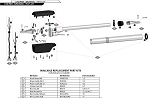
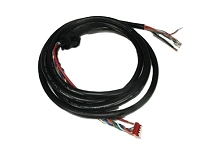
Are replacement parts from an XL operator compatible with the corresponding XLS model?
No, not automatically. Some GTO Pro XL components are shared with or superseded by parts that also support certain XLS models, but many actuators, rev counters, control boards, mounts, harnesses, and secondary arms are generation-specific. Compatibility must be established by the complete operator model and the replacement part number, not by matching the 2000, 3000, or 4000 family name alone.
XL and XLS Parts Must Be Checked Component by Component
The corresponding model number can create a false sense of interchangeability. A SW3000XL and SW3000XLS belong to the same capacity family, but the XLS revision introduced changes to operating speed, actuator feedback, front-mount construction, and scraper sealing. The SW4000XL and SW4000XLS have a similar relationship. The 2000XL and 2000XLS differ more substantially in actuator and controller design.
For that reason, there is no valid rule that says every 2000XL part fits a 2000XLS, every 3000XL part fits a 3000XLS, or every 4000XL part fits a 4000XLS. Each service part needs a verified cross-reference.
Control-Board Compatibility Does Not Follow One Pattern
| Part Group | XL-to-XLS Compatibility | What Must Be Verified |
|---|---|---|
| Main control board | Sometimes shared or superseded across selected families | Printed board number, operator model, connectors, charging input, motor wiring, limits, and service-board instructions |
| Actuator arm | Usually model- and generation-specific | Arm part number, stroke, retracted length, motor, feedback system, cable length, front mount, and primary or secondary use |
| Rev-counter or position-sensor board | Frequently generation-specific | Original sensor number, reed-switch or earlier feedback design, connector, magnetic wheel, and compatible main board |
| Brackets, housing, seals, and hardware | Some pieces span XL and XLS models | Exact part-number listing, bracket geometry, pin diameter, housing size, finish, and required stop arrangement |
| Receiver and accessories | May be reusable when electrically compatible | Frequency, code format, supply voltage, dry-contact logic, current draw, and terminal function |
A useful example is the R4211/R5211-style service-board family. Current replacement references commonly associate the R5211 with selected 2000XL, 3000XL, 3000XLS, 4000XL, and 4000XLS systems where that board is specified. The 2000XLS is an important exception: it uses the separate R4722/R5722 controller family. This shows why “XLS” alone does not identify the correct board.
Actuator Arms Should Not Be Crossed Without a Documented Match
An actuator is more than a 12-volt motor in a similar housing. The arm contains the screw drive, gearing, travel feedback, limit components, power cable, front mount, scraper seal, and mechanical stroke. XLS arms may run at a different speed and use a different rev-counter arrangement from the earlier XL arm.
The 2000XLS replacement arm is specifically identified for the 2000XLS family and has its own stroke and retracted-length specifications. Likewise, 3000XLS, 3200XLS, 4000XLS, and 4200XLS arms have model-specific primary or secondary cable arrangements. A secondary 3200XLS arm should not be assumed compatible with an older 3000XL dual system merely because both are 3000-series operators.
Rev Counters Are a Common XL-versus-XLS Trap
The XL-generation RVCTBDXL rev-counter board is associated with SW3000XL, SW3200XL, SW4000XL, and SW4200XL applications. The later R4918 reed-switch feedback board is associated with selected SW3000XLS, SW3200XLS, SW4000XLS, and SW4200XLS arms. These boards should not be swapped by appearance. The sensor, magnetic target, connector, arm generation, and main-board logic must agree.
A rev-counter fault can also be caused by a damaged arm cable, corroded connector, weak battery under load, dragging gate, or incorrect limit setup. Replacing the sensor without checking those conditions may leave the same symptom.
Some Mechanical Parts Can Cross Generations
Selected housing kits, bracket sets, stop plates, gate brackets, hardware bags, switches, alarms, and scraper seals are listed for both XL and XLS applications. Compatibility still depends on the exact service-part number. A bracket described for “3000XL(S)” or “4000XL(S)” may span both generations, while a front mount, pivot bracket, or housing component with a narrower model listing may not.
Do not reuse a bracket simply because the mounting holes appear close. A small change in pivot location alters actuator leverage, required stroke, closed position, and pinch-point clearance.
Technician’s Corner
Mixed Systems Are Common After Lightning Damage
South Florida surge events often result in a newer service board, external receiver, or control box being installed beside an older XL actuator. Identify the board and each arm separately. The enclosure label may no longer describe every component inside it.
Dual Gates Can Expose Speed and Feedback Differences
Mixing an XL arm with an XLS secondary arm may produce unequal travel speed, inconsistent sequencing, limit errors, or obstruction behavior even when both motors run. Use a documented primary-and-secondary pairing rather than trying to correct a hardware mismatch with delay settings.
Corrosion Can Make a Compatible Part Appear Incompatible
Moisture, salt air, battery fumes, and insect contamination increase connector resistance. Before condemning a replacement board or sensor, inspect the harness, terminal tension, splices, strain relief, and voltage at the component while the operator is moving.
Similar Terminal Labels Do Not Prove Board Compatibility
Two boards can both show cycle, safety, exit, lock, and motor terminals while using different charging circuits, limit logic, feedback inputs, or harness pinouts. Match the printed board number and current service instructions.
Before You Choose a Replacement Part
- Record the complete operator model, including XL or XLS and single or dual designation.
- Photograph the original part number, board revision, connectors, wire colors, and terminal layout.
- Confirm primary versus secondary arm and measure the actuator’s pin-center length and stroke.
- Verify battery voltage, transformer or solar input, fuse rating, receiver frequency, and accessory load.
- Check whether the replacement is a direct substitute, a superseded service part, or part of a conversion kit.
- Do not assume an isolated compatible component makes the complete XL and XLS systems interchangeable.
Related Technical Categories
- Gate Opener Circuit Boards
- Gate Opener Replacement Parts
- Swing Gate Openers
- GTO Pro Replacement Arms
- Gate Opener Batteries, Transformers, and Receivers
The practical answer is that selected parts cross from XL to XLS, but only when the manufacturer or current service listing identifies the exact part for both models. Before selecting replacement hardware, verify the operator model, part number, voltage, frequency, connector type, board revision, actuator stroke, feedback system, harness, and operator generation.
Tagged Products