
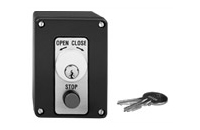
What additional mounting boxes, conduit fittings, wiring, relays, adapters, or weatherproof seals might be required?
A key switch may require more than the switch assembly. Depending on the operator, mounting location, and control circuit, the installation may also need a compatible surface or flush box, conduit hubs, low-voltage cable, weatherproof junctions, an isolated relay, a garage-door dry-contact adapter, surge protection, and gaskets that seal the complete enclosure rather than only the faceplate.
Start With the Key Switch Mounting Style
The required hardware changes depending on whether the key switch is designed for a standard single-gang box, a manufacturer-specific surface enclosure, a recessed rough-in box, or a post-mounted cabinet. The faceplate dimensions do not confirm that the switch body, cylinder, terminal block, and wire bends will fit behind the wall.
Surface-Mount Boxes
A surface-mount key switch normally needs a matching back box with enough depth for the switch block, cylinder, terminals, connectors, and a service loop. Outdoor models may require a cast-metal or gasketed enclosure. Check the mounting pattern, conduit entries, and whether the gasket is included.
Flush and Recessed Boxes
A flush key switch may mount to a standard single-gang electrical box, but some assemblies require a deeper box, trim ring, or dedicated rough-in enclosure. Verify the wall depth before cutting masonry, stucco, or a metal pedestal. A shallow box can force conductors against the switch terminals or prevent the faceplate gasket from compressing evenly.
Posts, Pedestals, and Gate Columns
Pedestal installations may require a mounting plate, adapter plate, post cap, internal back box, or a switch model made specifically for post mounting. Do not depend on the decorative faceplate to bridge an oversized opening. The box or adapter must support the switch mechanically and prevent movement when the key is turned.
Conduit Fittings and Cable Entry
Outdoor conduit entry may require threaded hubs, liquid-tight fittings, cable glands, locknuts, bushings, sealing washers, or listed wet-location fittings that match the box and conduit type. Choose fittings by the enclosure knockout size and wall thickness rather than by conduit size alone.
Use conduit sweeps that allow the cable to be replaced without damaging its insulation. A nipple may be needed between a pedestal and junction box. Seal unused knockouts with compatible plugs.
Route low-voltage control wiring separately from line-voltage motor and power conductors as required by the operator instructions and applicable electrical rules. Shared conduit can introduce electrical noise and may violate the insulation or separation requirements for the conductors being used.
Wiring and Connection Hardware
A simple momentary normally open key switch may use two conductors: command and common. Additional conductors may be required for separate open and close commands, a normally closed stop circuit, an indicator lamp, a heater, a buzzer, or multiple isolated switch contacts.
Confirm conductor gauge, insulation rating, wet-location suitability, and complete round-trip distance. The terminals may also require spade terminals, ferrules, ring terminals, terminal blocks, or approved plug connectors. Exterior splices should use a weather-resistant junction box and suitable wet-location splice method.
When a Relay or Adapter Is Required
Isolated Interposing Relay
An isolated relay may be needed with a powered access system, an electrically noisy long run, or a mismatched switch contact rating. It is usually placed near the operator so its dry contacts provide a short connection between the correct command and common terminals.
Verify the relay coil voltage, AC or DC type, current draw, contact arrangement, and whether the operator expects momentary or maintained operation. A relay does not correct incorrect command logic; it only isolates or translates the control circuit.
Garage-Door Dry-Contact Adapter
Some residential garage door openers use an electronic or polarity-sensitive wall console instead of a basic push-button input. In those systems, a mechanical key switch may require an operator-approved dry-contact adapter or interface. Connecting the switch directly to the wall-control terminals can cause no response, loss of wall-console functions, or inconsistent operation.
External Power Supply or Transformer
A purely mechanical switch may not need power. An illuminated cylinder, LED, heater, buzzer, timer, or relay may require a separate listed power supply or transformer. Match the voltage, frequency when applicable, polarity, current demand, and standby load. Do not assume that the operator’s accessory output has enough capacity for every added device.
Weatherproof Seals and Corrosion Protection
Outdoor reliability depends on sealing the entire assembly. Additional parts can include faceplate and back-box gaskets, sealing washers, a rain hood, conduit hub seals, knockout plugs, cable glands, and a gasketed junction box. Use seals made for the enclosure; excessive foam or sealant can trap water or distort the faceplate.
Seal the mounting surface where permitted, but preserve designed drain or weep paths. Keep wire entries below sensitive components when possible and form a drip loop on exposed cable. Stainless faceplates still need corrosion-resistant internal hardware.
Technician’s Corner
Field Note: Box Depth Is a Compatibility Specification
A plate can match a single-gang pattern while the cylinder and switch block extend too far into the wall. Measure the complete rear depth with terminals attached, not only the faceplate.
Field Note: Similar Relays May Produce Different Results
A relay with the wrong coil voltage will not operate correctly, and a maintained relay output is not interchangeable with a timed momentary pulse. Match both the coil side and contact side of the relay.
Field Note: South Florida Moisture Often Enters Through Conduit
Condensation and wind-driven rain can travel through a pedestal or underground conduit even when the faceplate gasket is intact. Sealed fittings, appropriate drainage, corrosion-resistant terminals, and surge protection are especially important on long outdoor runs.
Field Note: Do Not Seal In Water
Heavy caulk around every opening can create a reservoir inside the box. The goal is controlled weather resistance with correct gaskets, fittings, and drainage—not simply covering the enclosure with sealant.
Before You Match This Hardware
- Confirm surface, flush, wall, post, pedestal, or single-gang mounting.
- Measure faceplate size, rear depth, cylinder clearance, and box opening.
- Identify every required conductor and the complete cable distance.
- Verify dry-contact, powered, electronic, or polarity-sensitive control logic.
- Confirm momentary or maintained operation and N.O., N.C., or SPDT contacts.
- Match relay coil voltage, contact rating, adapter model, and power-supply capacity.
- Check conduit size, knockout size, fitting type, enclosure rating, and gasket availability.
- Plan weather-resistant splices, surge protection, grounding, drainage, and corrosion control.
Final Parts-Selection Check
Before selecting installation hardware, verify the operator model, control-board part number and generation, switch contact type, voltage, frequency when applicable, connector or terminal type, mounting dimensions, wire gauge, conduit entry, and enclosure rating. Two boxes, relays, or adapters that look similar may not be mechanically or electrically interchangeable.
Related Technical Categories
- Key Switches and Key Stations
- Surface and Flush Mounting Boxes
- Gate Access Control Relays
- Garage Door Dry-Contact Adapters
- Low-Voltage Control Wire
- Weatherproof Junction Boxes and Conduit Fittings
- Surge Protection and Power Supplies
