
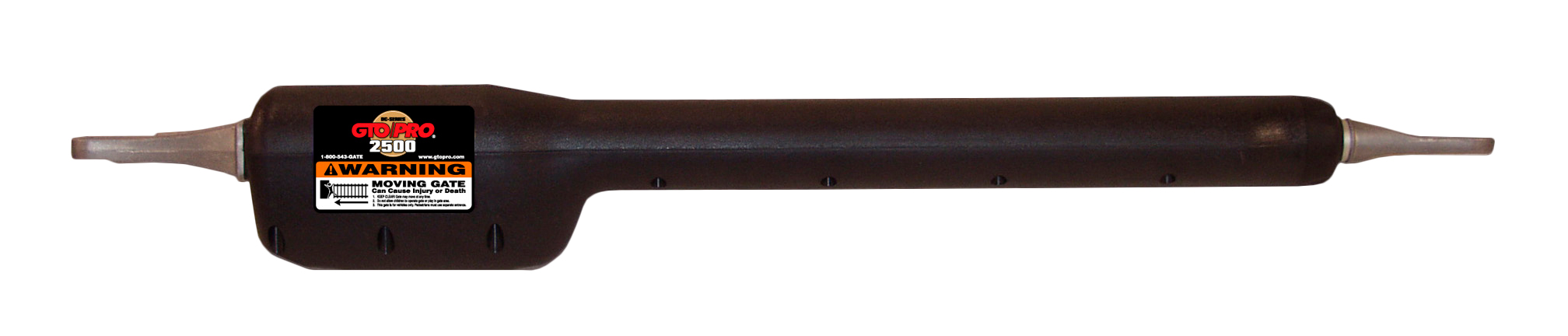
How much gate weight and gate length can a replacement operator arm safely handle?
A replacement operator arm can safely handle only the gate length and weight approved for its exact operator model, control system, mounting geometry, and duty cycle. Do not treat maximum length and maximum weight as independent limits. Longer leaves create greater leverage, while solid panels, wind, poor hinges, and incorrect brackets can reduce the practical capacity substantially.
Use the Rating for the Complete Operator System
A replacement arm does not receive a universal capacity simply because its motor, tube, or housing appears heavy. Its safe application is determined by the complete listed operator system: actuator, control board, brackets, power supply, limits or encoder, gate geometry, cycle demand, and required safety devices.
When the replacement is the same manufacturer service arm or a documented supersession, use the capacity chart for the exact operator model and generation. Do not transfer the rating from a visually similar arm, a newer model, or another control-box family. A replacement actuator connected to an older board may also operate at a different speed, current threshold, or duty cycle than a complete current-generation system.
Gate Length and Weight Must Be Evaluated Together
Swing-gate capacity is not a simple “maximum feet plus maximum pounds” calculation. Gate length increases the distance between the hinge and the gate’s center of mass. That increases the turning load applied to the hinges, brackets, and actuator even when the measured weight stays the same.
For that reason, some manufacturers publish a capacity curve or paired limits showing that a longer leaf must weigh less than a shorter leaf. A rating described as “up to” a certain length or weight should not be interpreted as approval for the longest gate at the heaviest published weight unless the model documentation expressly confirms that combination.
| Application Factor | Why It Changes the Required Capacity |
|---|---|
| Gate-leaf length | A longer leaf creates greater leverage and places more load on the hinges and actuator mounting points. |
| Gate weight | Heavier construction increases starting load, stopping load, hinge friction, and bracket stress. |
| Solid surface area | Wood, composite, privacy panels, and sheet metal create wind load not represented by static weight. |
| Mounting geometry | Incorrect hinge-to-pivot dimensions reduce leverage and can force the arm near its mechanical limits. |
| Cycle demand | Frequent operation increases motor, gearbox, battery, charger, and control-board thermal load. |
Measure One Gate Leaf, Not the Entire Driveway Opening
For a dual swing gate, capacity is generally evaluated per moving leaf, but the exact manual must control the decision. Measure from the hinge center to the far end of each individual leaf and determine the weight of each leaf separately. Do not divide the total gate weight evenly unless both leaves are actually identical.
One leaf may contain a pedestrian section, heavier ornamental work, solid infill, a lock receiver, or a different frame. It may also face greater wind pressure or use different hinge and bracket geometry. Each actuator must be suitable for the leaf it moves, and the control board must support the combined dual-gate duty.
Static Gate Weight Does Not Equal Operating Load
A scale weight does not include hinge drag, gate sag, post movement, wind, an uphill swing, a binding lock, or a bracket that flexes under load. Disconnect the operator and move the gate through its complete arc. The leaf should remain supported and move smoothly without tightening near the open or closed position.
The operator arm should move the gate, not lift it, realign it, or hold a failing hinge post in place. A gate that is within the published weight limit can still overload the arm when the hinges are dry, worn, undersized, or out of alignment.
Wind Load Can Be the Controlling Specification
Solid and partially solid swing gates act like sails. Wind pressure increases with panel area and can load the actuator differently throughout the opening arc. A gate may operate normally in calm weather and stall, reverse, or bend hardware during gusts.
In South Florida, evaluate gate height, leaf length, percentage of open area, prevailing wind exposure, nearby walls, storm conditions, and the strength of the post and bracket attachments. Do not select an arm from gate weight alone when the leaf has privacy panels, wood boards, composite infill, or sheet metal.
Technician’s Corner
Field Note: “Maximum” Is Not a Design Target
A published maximum assumes the conditions and geometry defined by the manufacturer. Operating continuously at the edge of the rating leaves less allowance for wind, aging hinges, battery voltage drop, corrosion, and future gate modifications.
Field Note: Dual Arms Do Not Double the Rating of One Leaf
Installing two actuators on two separate leaves does not mean one oversized leaf can carry twice the single-arm rating. Each arm moves its own leaf, and each leaf must remain within the approved length, weight, geometry, and wind-load limits.
Field Note: Bracket Leverage Can Make a Properly Sized Arm Look Weak
If the post pivot is located incorrectly, the actuator may have poor leverage near an endpoint and draw excessive current. Verify the model-specific hinge-center measurements before selecting a larger arm or increasing force settings.
Field Note: Battery and Solar Capacity Affect Real-World Operation
A battery-backed or solar system may be mechanically capable of moving the gate but unable to sustain the required cycle count during low charging conditions. Gate load, battery condition, panel exposure, accessory draw, and repeated cycles must be considered together.
Before You Choose a Replacement Arm
- Identify the exact operator, actuator, and control-board part numbers and revisions.
- Find the manufacturer’s approved gate-length and gate-weight chart for that model.
- Measure each leaf from the true hinge center and determine its individual weight.
- Record gate height, construction, solid infill percentage, and wind exposure.
- Confirm hinge condition, post stability, physical stops, and free manual movement.
- Verify push-to-open or pull-to-open bracket geometry and opening angle.
- Confirm residential, commercial, or continuous-duty cycle requirements.
- Check battery, charger, solar, voltage-drop, and accessory-power requirements.
Related Technical Categories
Before selecting replacement hardware, verify the operator model, arm part number, voltage, frequency where applicable, connector type, control-board generation, stroke, limit or encoder system, bracket geometry, gate-leaf length, gate weight, duty cycle, and wind exposure. Use the exact manufacturer capacity chart rather than a generic arm size or appearance.
Tagged Products


