What information do I need from my gate or garage door operator before ordering a key switch?
Before ordering a key switch, record the operator’s brand, complete model number, control-board part number or revision, available activation terminals, and the input logic shown in the manual. Also identify whether the switch must be momentary or maintained, normally open or normally closed, single- or dual-direction, indoor or outdoor, and surface-, flush-, or post-mounted.
Why the Operator Information Matters
A key switch must match the operator’s electrical command input, not just the faceplate or key-cylinder style. Gate boards may use full-open, partial-open, open-only, close, stop, or single-button cycle inputs. Garage operators may use a conventional low-voltage input, a three-button circuit, or an electronic wall console that does not accept a basic mechanical contact closure.
Two switches that look alike can operate differently. One may spring back when released; another may stay latched. One may provide normally open contacts, while another provides normally closed or changeover contacts. The wrong action can cause no response, repeated commands, an unintended hold-open condition, or a control fault.
Record the Operator and Control-Board Identification
Operator Label and Manufacturing Generation
Photograph the identification label and record the complete brand, model, serial number, and manufacturing date when available. Operators with similar cabinets or model families may use different terminal layouts and wall-control technology across production generations.
Control-Board Part Number and Revision
Record the board part number, revision, and terminal legend. This becomes especially important when the original board has been superseded. A replacement board may fit the same operator while changing accessory terminals, programming, monitored-input requirements, or connector locations.
Exact Command Terminals
Use the wiring diagram to identify the intended external-control terminals. Common labels include OPEN, CLOSE, STOP, SBC, STEP, CYCLE, FULL OPEN, PARTIAL OPEN, RADIO, KEY, and COM. Do not choose a terminal by voltage measurement alone; a low-voltage terminal may still require a specific logic signal, monitored device, or isolated relay.
Determine the Required Switch Action
Momentary or Maintained
A momentary key switch changes contact only while the key is turned and usually returns to center. It is commonly used for a brief open or cycle command. A maintained switch stays in position and should be used only where the operator provides dedicated hold-open, disable, or other maintained-control logic.
Do not connect a maintained switch to a single-button cycle input unless the operator manual permits it. A continuously closed input may be ignored, generate repeated commands, or block normal operation. Constant-pressure control is also different from maintained hold-open operation and must follow the operator’s listed control method.
N.O., N.C., or SPDT Contacts
Many operator activation inputs use a normally open dry contact between the command terminal and common, but this is not universal. Some systems require normally closed supervision. An open-close key station may require a center-off switch with separate contacts for each direction. Confirm N.O., N.C., SPDT, pole count, and whether isolated contacts are required.
Dry Contact or Powered Accessory
A dry contact switches the operator’s own control circuit without sending outside voltage into the board. Never apply power to a dry-contact input unless the manual specifically calls for it. Illuminated switches, LEDs, heaters, buzzers, or internal relays may need separate power, so verify AC or DC voltage, current draw, polarity, and available accessory capacity.
Gate and Garage Operators Use Different Control Logic
Gate operators commonly provide dedicated access-control inputs, but terminal choice changes the result. Full-open and pedestrian inputs may behave differently, and some battery or solar boards enter a low-power state that requires a minimum contact duration before the command is recognized.
Residential garage openers need extra caution. Some older units accept a simple two-wire push-button closure, while newer generations may communicate electronically with the wall console. A standard key switch may then require a manufacturer-approved dry-contact adapter or interface. Commercial door operators may use single-button or three-button low-voltage controls instead.
Match the Mounting and Environment
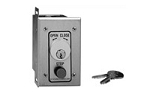
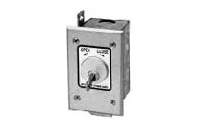
Identify whether the key switch will be flush-mounted in a single-gang box, surface-mounted, post-mounted, installed in a pedestal, or fitted into an existing enclosure. Measure the opening, box depth, conduit entry, faceplate size, and key-cylinder clearance.
For outdoor use, verify the rating of the complete assembly, not only the stainless faceplate. Check gasket design, drainage, conduit sealing, corrosion resistance, tamper protection, and whether the key can be removed in each switch position. Also decide whether the cylinder must be rekeyable, keyed alike, keyed differently, or part of a restricted key system.
Technician’s Corner
Field Note: Hold-Open Requires the Correct Input
A maintained key switch is not a universal hold-open control. It must connect to the input and logic identified for that purpose. On the wrong terminal, the same switch can create a stuck command instead of a controlled hold-open condition.
Field Note: Two Wires Do Not Always Mean Dry Contact
Some garage operators send electronic communication and accessory power over the same two wall-control wires. Matching by wire count alone can cause intermittent operation or make a standard key switch unusable without an approved interface.
Field Note: Outdoor Damage Often Starts Behind the Faceplate
In South Florida, humidity, salt air, wind-driven rain, insects, and condensation often enter through the box, conduit, or pedestal. Use sealed entries, corrosion-resistant terminals, drainage where appropriate, and system-level surge protection for long outdoor wire runs.
Field Note: Count Conductors Before Choosing Cable
A basic N.O. momentary command may need two conductors. Separate open and close commands, indicators, heaters, or multiple isolated contacts require more. Confirm every circuit before assuming an existing two-conductor cable is sufficient.
Before You Choose a Replacement Key Switch
- Photograph the operator label, control board, and terminal strip.
- Record the model, serial date, board part number, and revision.
- Confirm the exact command input and common terminal.
- Verify momentary or maintained action and key-removal position.
- Confirm N.O., N.C., SPDT, pole count, and dry-contact requirements.
- Verify any LED, heater, buzzer, or relay power requirements.
- Measure the mounting box, enclosure, conduit entry, and cylinder clearance.
- Confirm weather rating, corrosion resistance, keying, wire count, and wire distance.
Safety and Final Compatibility Check
A key switch is an activation device, not an entrapment-protection device. It must not bypass monitored photo eyes, sensing edges, obstruction logic, or other safety equipment required by the operator manual and listing. Mount user controls where the manual requires clear visibility and safe separation from the moving gate or door.
Before selecting hardware, verify the operator model, board part number, voltage, AC or DC requirement, contact configuration, connector or terminal type, operator generation, and frequency when a wireless interface is involved. Match the control logic rather than assuming a visually similar key switch is electrically interchangeable.
Related Technical Categories
- Key Switches and Key Stations
- Gate Access Control Devices
- Garage Door Wall Controls
- Access Control Relays and Interfaces
- Gate and Garage Operator Control Boards
- Weatherproof Pedestals and Enclosures
Tagged Products