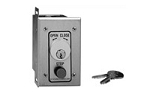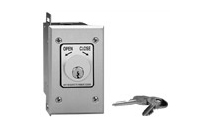
Are gate and garage door key switches universally compatible with all operators?
No. Gate and garage door key switches are not universally compatible because operators use different control inputs, contact logic, wiring methods, and accessory technologies. A compatible switch must match the operator’s required momentary or maintained action, normally open or normally closed contacts, terminal functions, voltage needs, mounting method, and control-board generation.
Why a Key Switch Is Not a Universal Accessory
A key switch is a mechanical command device, but the operator determines what that command must look like electrically. Many gate operators accept a normally open dry-contact closure between an activation terminal and common. Other systems use separate open, close, and stop circuits, maintained hold-open inputs, normally closed supervision, or programmable accessory inputs.
Residential garage door openers create an additional compatibility problem. Some older models respond to a basic two-wire push-button closure, while newer units may communicate electronically with a proprietary wall console. A conventional key switch connected directly to that circuit may not work and may require a manufacturer-approved dry-contact adapter, interface module, or compatible control station.
Dry Contact Does Not Mean Universal
Even when two operators accept dry contacts, the required switch action can differ. “Dry contact” only means the switch does not apply outside voltage to the command input. It does not confirm whether the board expects a momentary pulse, a maintained closure, a normally open contact, a normally closed contact, or separate contacts for different commands.
Momentary Versus Maintained Operation
A momentary switch changes state only while the key is turned and normally springs back to center. This is commonly used for open, cycle, or single-button commands. A maintained switch stays in the selected position and is used only when the operator provides a compatible hold-open, lockout, disable, or constant-contact function.
Installing a maintained switch on a momentary cycle input can leave the command continuously active. Depending on the board logic, the operator may ignore additional commands, repeatedly interpret the input, remain open, or display an active-input condition. The operator manual must specifically support the intended maintained function.
Normally Open, Normally Closed, and SPDT Contacts
Many gate activation terminals use a normally open contact that closes to common. Stop circuits and supervised inputs may use normally closed logic. An open-close key station may need a center-off SPDT or multi-pole switch with separate contacts for each direction. Matching the contact arrangement is more important than matching the faceplate appearance.
Gate Operators Can Use Different Command Inputs
A gate control board may provide full-open, partial-open, pedestrian, free-exit, radio, single-button, close, stop, or fire-access inputs. These terminals are not interchangeable. A key switch connected to full open may behave differently from one connected to a cycle or hold-open input, especially when an automatic close timer is enabled.
Some gate boards also require programmed and functioning entrapment-protection devices before normal access-control commands will move the gate. A compatible key switch cannot override a missing monitored photo eye, sensing edge, active stop circuit, or safety fault. The key switch initiates a command; it does not replace the required safety system.
Garage Door Operators Require Extra Verification
Residential garage openers may have two wall-control wires without using a simple mechanical contact closure. The wall console can carry power, polarity-sensitive wiring, lock functions, light control, and digital communication over the same conductors. Wire count alone does not prove that a standard key switch can be connected directly.
Commercial door operators may use three-button open-close-stop controls, single-button controls, constant-pressure close logic, or programmable commercial control stations. A residential-style single-button key switch may not provide the separate circuits or operating mode required by a commercial operator.
Powered and Illuminated Key Switches Add More Variables
A basic dry-contact key switch may not require accessory power, but illuminated models, heaters, buzzers, timers, or internal relays can. Verify the required AC or DC voltage, polarity, current draw, and available accessory power at the operator. Never apply power to a dry-contact command terminal unless the operator manual specifically directs it.
Also confirm whether the key switch contacts are rated for the control circuit. The switch may be physically suitable for outdoor use while its internal lamp, heater, or relay is electrically incompatible with the operator’s accessory output.
Technician’s Corner
Two Similar Faceplates Can Hide Different Switch Logic
One key station may be momentary center-return, while another remains in the open position. A third may use separate open and close contacts. The cylinder and stainless plate can look nearly identical even though the switch blocks are not electrically interchangeable.
South Florida Exposure Changes the Hardware Requirement
Outdoor pedestals and gate posts are exposed to humidity, condensation, wind-driven rain, salt air, insects, and lightning-related surges. Verify the rating of the complete enclosure, gasket, conduit entry, terminal hardware, and powered components. A stainless faceplate alone does not make the entire assembly weather resistant.
Existing Cable Can Limit the Correct Replacement
A two-wire cable may support one momentary dry-contact command but not separate open and close functions, an indicator lamp, a heater, or a normally closed stop circuit. Count the required conductors before choosing the switch configuration.
Hold-Open Must Be Matched to Board Logic
Do not assume that turning and leaving the key will safely hold every gate or door open. The operator must provide a designated maintained or hold-open input. Using the wrong terminal can create a stuck command instead of the intended operating mode.
Before You Match This Hardware
- Record the operator brand, complete model number, serial date, and control-board part number.
- Identify the exact command terminals and common terminal in the operator manual.
- Confirm momentary, maintained, or constant-pressure operation.
- Verify normally open, normally closed, SPDT, and pole requirements.
- Determine whether the wall-control circuit is dry contact, powered, polarity-sensitive, or digitally communicating.
- Verify voltage, AC or DC type, current draw, and accessory power for illuminated or heated models.
- Check the mounting style, enclosure dimensions, conduit entry, cylinder type, and outdoor rating.
- Confirm that required monitored photo eyes, sensing edges, and stop circuits remain functional.
Final Compatibility Rule
A key switch should be selected by electrical function and operator documentation, not by appearance or a “universal” label. Verify the operator model, control-board generation, part number, voltage, contact type, switch action, terminal arrangement, connector or wire requirements, and mounting environment before selecting replacement hardware.
Related Technical Categories
- Key Switches and Key Stations
- Gate Access Control Devices
- Garage Door Wall Controls
- Commercial Door Control Stations
- Access Control Relays and Interfaces
- Gate and Garage Operator Control Boards
Tagged Products