
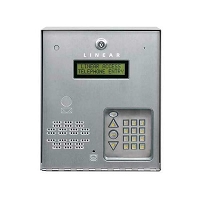
Do telephone entry systems still work with landlines, VoIP, or digital phone service?
Many telephone entry systems still work with traditional landlines, but VoIP and digital phone service must be verified before reuse. Older call boxes often expect analog dial tone, ring voltage, loop current, DTMF tones, and clean disconnect behavior. Digital service can work through an analog adapter, but not every entry system or gate-release tone behaves correctly.
Why Phone Service Type Matters
A telephone entry system does more than place a voice call. It must ring the correct resident or manager, allow a conversation, recognize the gate-release tone, and activate a relay output tied to the gate operator or door control hardware. The phone connection is only one part of the access-control path.
Older telephone entry units were commonly designed around traditional analog telephone service. That type of line provided predictable voltage, ring cadence, dial tone, and tone transmission. When the same system is connected to VoIP, cable phone, fiber phone, or another digital service, the signal is usually being converted through equipment such as a modem, ONT, gateway, or analog telephone adapter. That conversion can change how the entry system detects calls, tones, hang-up, and remote programming commands.
Traditional Landlines
A true analog landline is often the cleanest match for older telephone entry systems, especially units designed for RJ11-style telephone-line input. If the line is active, stable, dedicated, and free of noise, the system may continue to operate as originally intended.
The limitation is availability and long-term support. Many properties no longer have traditional copper service, and some “phone lines” that look analog at the jack are actually digital voice service converted through a provider device. Before assuming a landline is present, confirm whether the service is true analog copper or a digital voice port presented as analog.
VoIP and Digital Phone Service
VoIP and digital phone service can work with some telephone entry systems, but compatibility is not automatic. The entry system must be able to place and receive calls through the adapter, pass DTMF tones clearly, detect ring and disconnect conditions, and avoid timing problems caused by compression, echo cancellation, or packet delay.
The most common field problem is not the voice call itself. The visitor and resident may hear each other clearly, but the entry system may not recognize the resident pressing the open command. That open command is usually a DTMF tone, and if the tone is distorted, shortened, converted incorrectly, or filtered by the VoIP path, the gate may not release.
Digital Phone Service Is Not the Same as Old Copper
Cable phone, fiber phone, and provider-supplied digital voice service often provide an analog-looking phone jack, but the service still depends on powered electronics. The modem, ONT, router, gateway, or analog adapter must remain powered for the phone path to stay alive. A gate operator battery backup does not automatically power the phone-service equipment.
This matters at gated communities, commercial entrances, storage yards, and residential gates where visitor access is expected during storms or outages. If the communication path fails, the entry panel may still power up locally but be unable to call out.
Remote Programming and Modem Functions
Some older telephone entry systems used the phone line for more than visitor calls. They may have supported modem-style programming, call forwarding setup, remote database changes, or line-based programming commands. These functions are more sensitive than basic voice calling and may not work reliably through VoIP or digital phone adapters.
If the site relies on remote programming, resident-directory updates, schedules, or access-code changes over the phone line, verify that the replacement communication method supports those functions. A system that can make a voice call may still fail during programming sessions.
Technician’s Corner
DTMF Is the Gate-Release Detail That Gets Missed
Many telephone entry systems open the gate when the resident presses a number on the phone. The tone must pass cleanly through the phone service and be decoded by the entry system. If the relay never activates, the problem may be tone handling rather than the gate operator.
South Florida Storm Conditions Expose Weak Phone Paths
Heat, humidity, lightning activity, water in conduit, and corroded splices can create intermittent phone-line problems. A replacement panel may not solve call failures if the phone service path, grounding, or underground wiring is already compromised.
Power Backup Must Cover the Entire Chain
For digital phone service, backup power must cover the entry system, provider modem or ONT, router if required, network switch if used, and any access-control power supply. Backing up only the gate operator can still leave the telephone entry system unable to communicate.
Relay Output Is Separate From Phone Compatibility
The phone service handles the call. The gate still receives an open command through relay contacts, commonly common and normally open terminals tied to the operator input. Always verify relay wiring separately from phone-line compatibility.
Before You Match This Hardware
- Confirm whether the current service is true analog landline, VoIP, cable phone, fiber phone, or another digital voice service.
- Verify the telephone entry system model number, board number, firmware or revision, and phone-line terminal labeling.
- Test whether the system can place calls, receive calls, pass DTMF gate-release tones, and detect hang-up correctly.
- Check whether the system uses the phone line for remote programming, resident directory updates, call forwarding, or modem access.
- Confirm whether the phone service requires a modem, ONT, gateway, router, analog adapter, battery, or UPS.
- Inspect phone-line wiring for corrosion, water intrusion, poor grounding, surge damage, and loose terminations.
- Verify relay output wiring to the gate operator, door controller, electric strike, or maglock power supply.
When Cellular or IP Replacement May Be Better
If an older telephone entry system becomes unreliable after a phone-service change, it may be better to move to a cellular or IP-based entry system instead of forcing legacy hardware onto a digital voice path. Cellular systems can reduce dependence on old underground phone wiring. Internet-based systems can support video, app access, web programming, audit trails, and multi-door management when the network is stable.
The right choice depends on the property. A simple voice-only gate may still work well with a stable landline. A multi-tenant property with frequent user changes may benefit from a newer access platform. A remote gate without dependable wiring may be a better candidate for cellular service.
Related Technical Categories
- Telephone Entry Systems
- Cellular Access Control Equipment
- Access Control Keypads and Readers
- Gate Opener Circuit Boards
- Gooseneck Pedestals and Mounting Hardware
Final Selection Rule
Traditional landlines are usually the safest match for older analog telephone entry systems when the line is clean and supported. VoIP and digital phone service can work, but only after confirming tone handling, ring behavior, disconnect supervision, adapter compatibility, and backup power. Before selecting replacement hardware, verify model number, part number, voltage, phone-service type, relay output, connector type, credential format, enclosure size, and gate operator generation.
Tagged Products


